
Geological Orogen: Archean to Neoproterozoic
The geology of Central Africa is dominated by Precambrian cratons of Archean and Lower Proterozoic age, Pan-African mobile zones of Upper Proterozoic age and intracratonic sedimentary basins ranging from the Proterozoic to the Quaternary.
The Precambrian history of this part of Africa is commonly described as a process of progressive cratonization, or the gradual addition (also called accretion) of a series of successively younger mobile or orogenic zones or belts to the oldest crustal nuclei (older land) of early Archean age.
Such zones are related to major orogenic events, like regional metamorphism (a process by which the original composition of rocks is being severely altered by pressure and heat), folding and the emplacement of plutonic or volcanic rocks. Occasionally, subsequent orogenic belts developed inside existing cratons (land, which has already stabilized), but more commonly they added to the size of older cratons by addition of new crustal material along their margins.
Most of the cratons in the area under discussion stabilized already during the Archean after the accretion of only Archean mobile zones subsequent to orogenic events. The North Gabon Archean nucleus for example stabilized around 2.7 Ga.
The Archean-Lower Proterozoic cratons consist essentially of granitic-gneissic terranes and of volcano-sedimentary and sedimentary greenstone belts (greenstone is a field term, which is applied to altered basic igneous rocks which owe their green color to chlorite and other minerals).
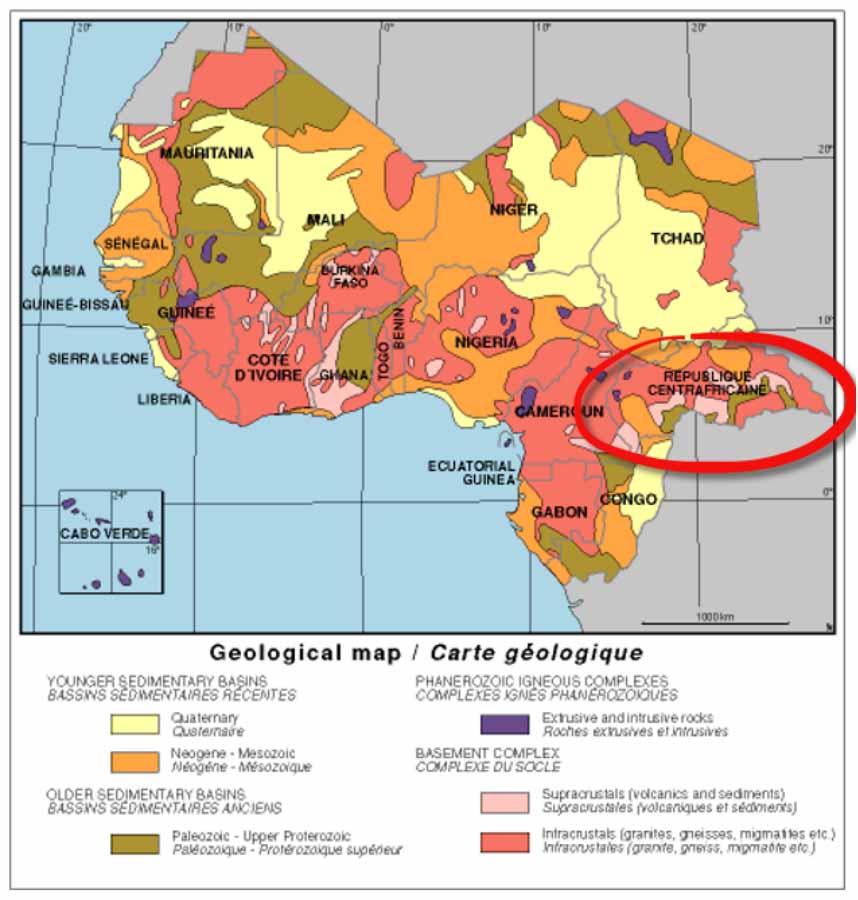
The greenstone belts, which are of either Archean or Lower Proterozoic age, are host to significant precious metal, base metal and bulk mineral deposits world-wide. Archean greenstone belts occur in most of the fragmented cratons of West- and Central Africa.
The last orogenic event in West- and Central Africa was the Pan-African of Upper Proterozoic to Lower Paleozoic age (600-450 Ma). This event completed the addition of new crustal material to the older cratons, it also overprinted and partially obliterated older pre-existing sequences of Archean-Late Proterozoic age. Pan-African mobile belts rim the western margins of the West-African and Congo cratons: Mauritanides, Rokelides and Ubangides.
Geological Orogen: Post-Precambrian
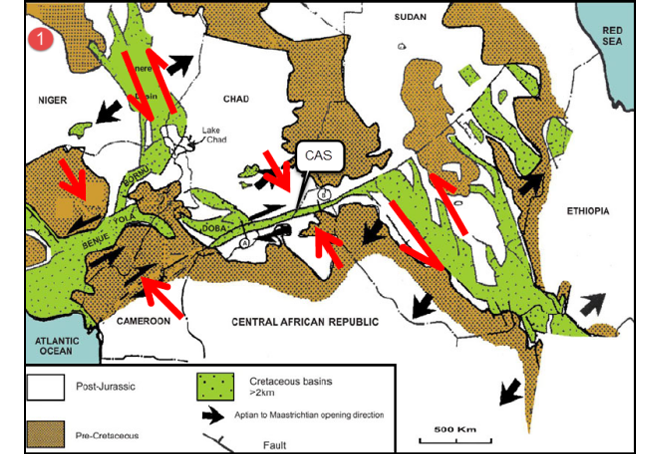
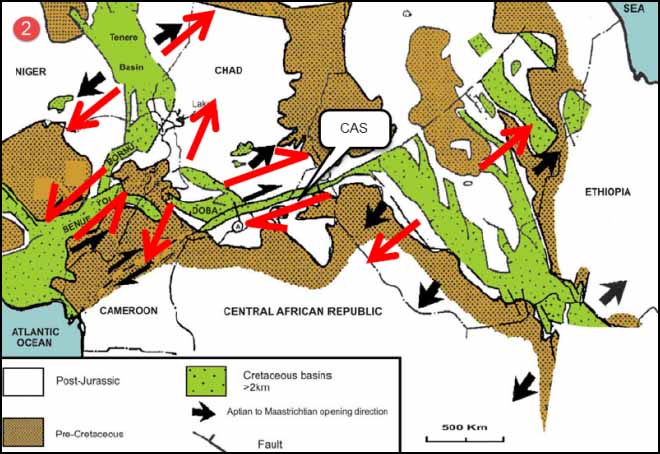
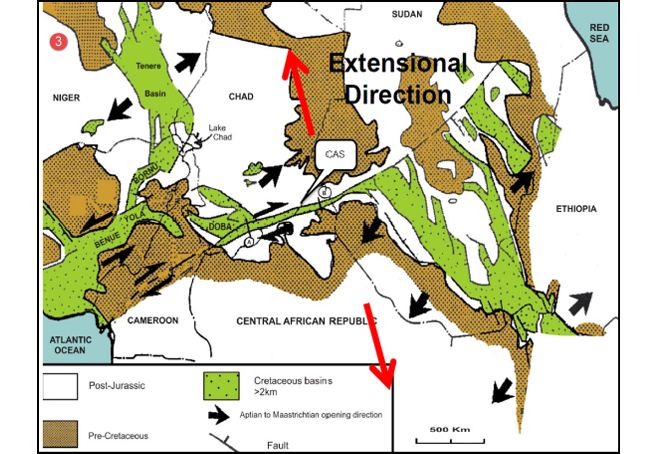
The Central African sub-system exhibits a similar geometry, with a major ENE-oriented strike slip zone showing in this case dextral movement (Ngangom, 1983; Cornacchia and Oars, 1983). Narrow “puIl-apart” basins are located along the length of the strike-slip zone which extends from Cameroon through southern Chad and the Central African Republic into west-central Sudan. Movement along this fault system dissipated into a series of NW-SE orientated rift basins which extend into southern Sudan and Kenya (McHargue et aI., 1992).
Tectonic Map
Up to 60% of bedrock beneath the Central African Republic dates to the Precambrian. Much of the country is situated on the Archean Congo Craton. The North Equatorial Fold Belt, Pan-African granulites and greenstone belts are found in the north and center of the country. Cretaceous sandstones span the west and central areas of the republic. The Bakouma Formation includes extensive carbonates, glacial outwash and tillite deposits dated to the Neoproterozoic.
Stratigraphically, the lower units of Precambrian (Archean) rocks consist of granite, amphibolite, gneiss and gneissic-migmatite rock, likely dating to the Neoarchean.
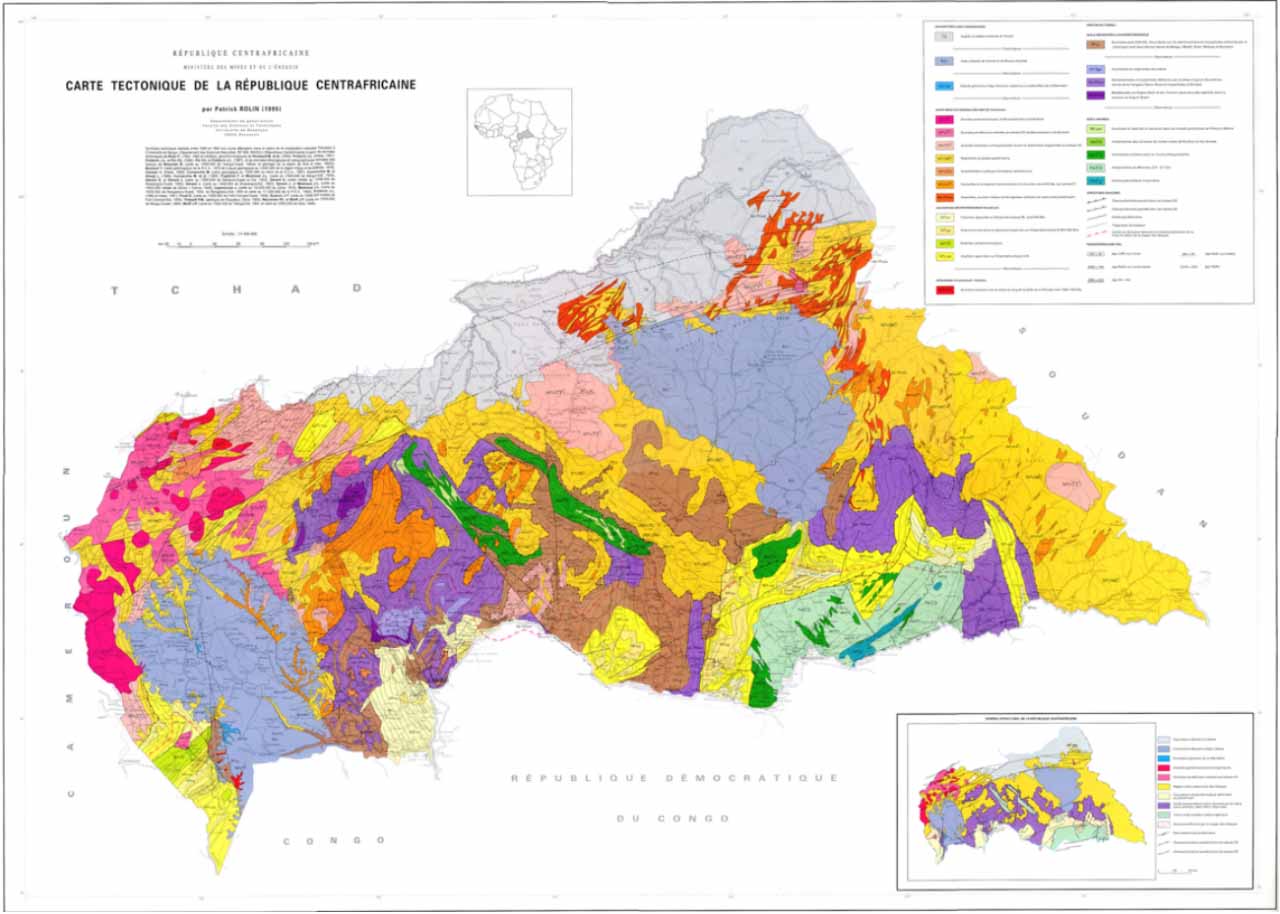
These sequences, divided into the Bandas Belt and Dekoa Belt, are often described as a greenstone belt.
Granitoid batholiths and dolerite dykes dating to the Proterozoic frequently intrude into these layers. The upper sequence is Neoproterozoic age quartzite and schist and tends to be folded, but only weakly metamorphosed. In the west, the Mambere Formation and the Kombele Formation in the east each record glacial sediments, while erosion and river activity left behind the Cretaceous Mouaka-Ouadda and Carnot-Berberati sandstone formations.
Metallogenic Map
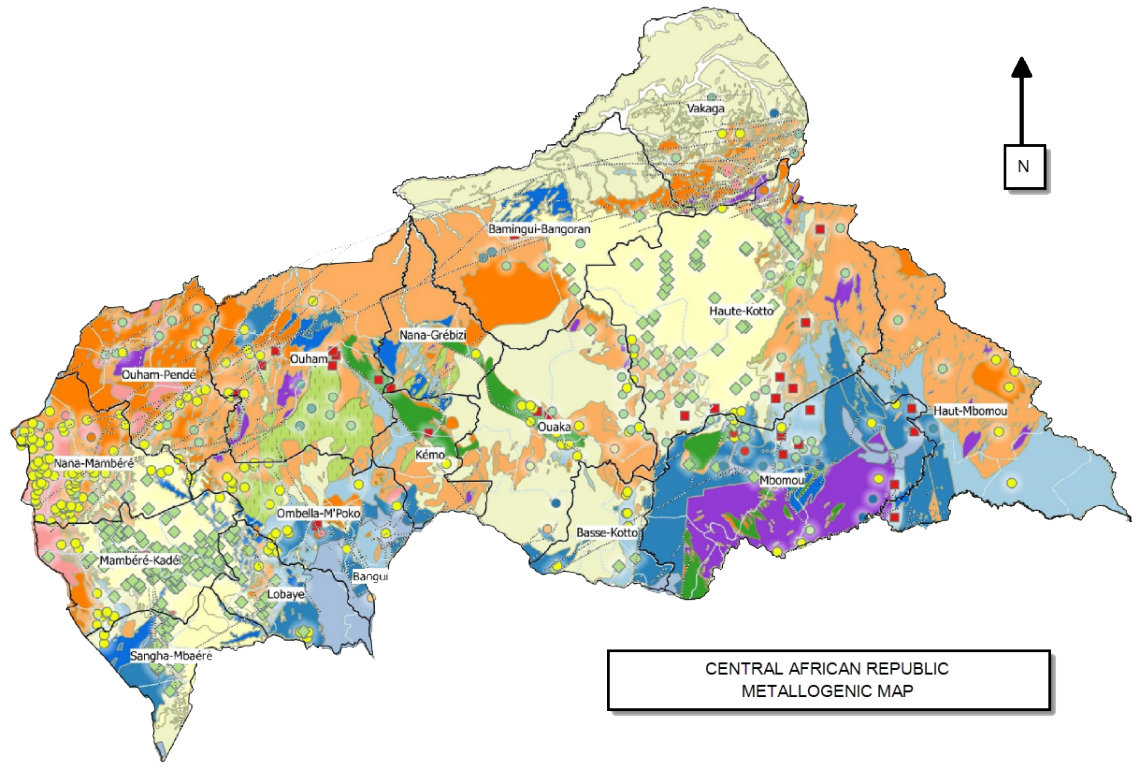
Gold – Precambrian Greenstone belts of CAR, being host to several producing mines already, have excellent potential for additional gold deposits. Their exploration potential is comparable to other greenstone belts in the world.
Diamonds – CAR has a long history of diamond production, originating for the most part from fluviatile placers. Only a small fraction of total production derives from altered kimberlites. The majority is produced from heavy mineral concentrations associated with older Paleozoic quartzites.
Copper, Lead and Zinc – There is a good and virtually unrealized potential for volcanic associated massif sulphide (VMS) copper, lead and zinc deposits, associated with Archean and Lower Proterozoic greenstone belts of the Central African massifs.
Tin and tungsten – Tin mineralization is related to various generations of granites, alkali-granites arranged as ring complexes and associated rhyolites and pegmatites. Tin occurrences are essentially associated with the Late Proterozoic Pan-African intrusions in the NW of CAR.
Phosphate – Several uranium-rich sedimentary phosphate deposits of significant phosphate grade and volume are known in CAR.
Industrial Minerals – Potential indications of industrial minerals in the region include graphite, rare earth minerals, silica sand, lithium, talc, limestone and marble.